Paid media is often misunderstood inside organizations. For many teams, it is seen as a tactical activity focused on launching ads, driving clicks, and delivering immediate conversions. Budgets are assigned to platforms, campaigns are optimized for short-term efficiency, and performance is judged mainly through surface metrics such as ROAS or cost per acquisition.
This way of thinking creates a dangerous limitation. It reduces paid media to a spending function rather than recognizing it as a strategic growth system. When paid media is treated only as advertising, brands struggle to scale sustainably, customer acquisition costs rise over time, and growth becomes increasingly dependent on constant budget increases.
In reality, paid media is far more than ads. It is a structured way to influence demand, guide customer decision-making, reinforce brand positioning, and balance short-term performance with long-term growth. When designed strategically, paid media becomes a lever that connects business objectives, customer behavior, creative messaging, and measurement into one coherent framework.
This article explains how paid media should be understood and executed as a strategic discipline rather than a collection of isolated campaigns.
Rethinking Paid Media From Execution to Strategy
At its simplest level, paid media means paying to place a message in front of an audience. While this definition is technically accurate, it ignores the strategic questions that truly matter. Strategy begins when marketers move beyond asking how much to spend and instead ask why they are spending, who they are trying to influence, and how behavior should change over time.
A strategic view of paid media focuses on intent and impact rather than immediate outputs. It considers how paid exposure affects brand memory, shapes perceptions, and influences future decisions even when a purchase does not happen immediately.
Paid media strategy answers questions such as:
- What role should paid media play in overall business growth?
- Which customer decisions are we trying to influence at each stage of the journey?
- How does this investment support both current revenue and future demand?
Without this level of thinking, paid media becomes reactive and fragmented. With it, paid media becomes purposeful and scalable.
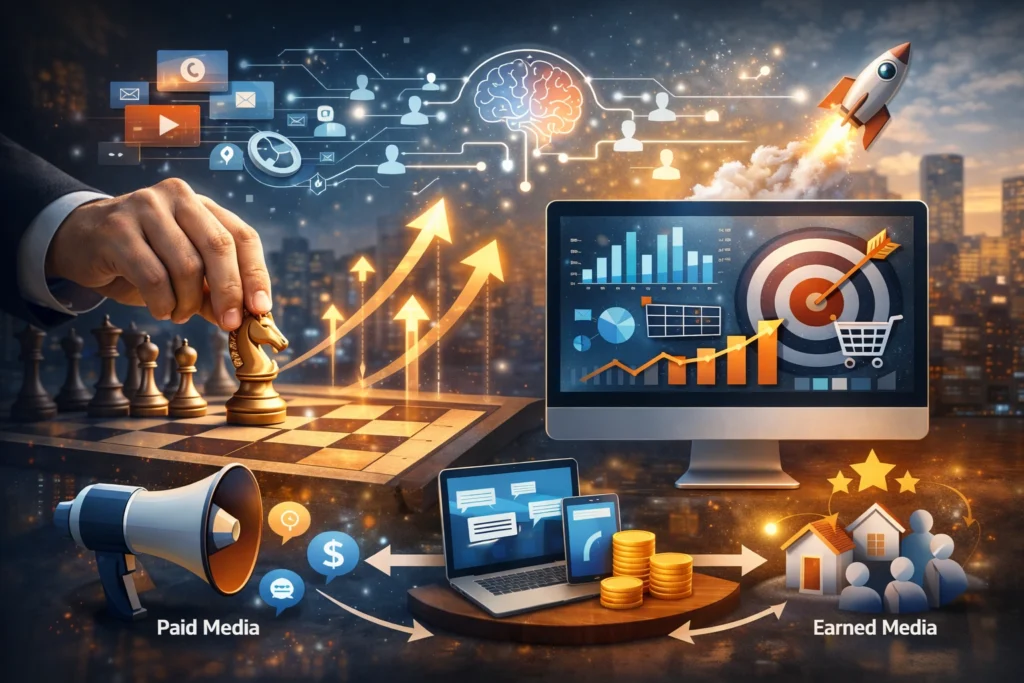
Paid, Owned, and Earned Media as an Integrated Growth System
Sustainable growth does not come from paid media alone. It comes from how paid media works together with owned and earned media. Each plays a distinct role, and their interaction creates long-term advantage.
Paid media provides reach and control. It allows brands to enter the customer’s field of vision at specific moments and at meaningful scale. However, paid media alone cannot build trust or depth.
Owned media provides continuity and substance. These are assets such as websites, blogs, newsletters, and brand-owned social channels. Owned media allows brands to educate customers, tell deeper stories, and build long-term relationships without paying for every interaction.
Earned media represents advocacy and credibility. This includes reviews, recommendations, shares, and word-of-mouth. Earned media carries a level of trust that paid messages cannot replicate.
The strategic power lies in their interaction. Paid media introduces and reinforces the message. Owned media deepens understanding and engagement. Earned media amplifies credibility and reach. Brands that rely too heavily on only one of these channels eventually face diminishing returns.
The Strategic Role of Paid Media in Customer Acquisition
Paid media plays a unique role in customer acquisition because it allows brands to influence customers at multiple decision points. It is not limited to capturing existing demand. It can also create demand where none previously existed.
From a strategic perspective, paid media serves three core purposes:
- It builds awareness by introducing the brand or category to new audiences.
- It shapes consideration by influencing how customers evaluate options.
- It captures intent when customers are ready to make a purchase.
Each of these purposes requires different messaging, different channels, and different success metrics. Treating all paid media activity as conversion-focused undermines its broader impact.
Paid Media Across the Marketing Funnel
The effectiveness of paid media depends heavily on where the customer is in their decision journey. Expecting the same channel or campaign to perform equally well at every stage leads to poor decision-making.
Top of the Funnel: Awareness
At the awareness stage, customers may not recognize a need or may not know the brand exists. The objective here is not immediate action but visibility and memory creation.
Paid media at this stage focuses on reach and frequency. Channels such as display advertising, paid social awareness campaigns, and digital video are particularly effective because they can expose large audiences to the brand in a cost-efficient way.
Success at this stage is measured through metrics such as impressions, reach, and cost per thousand impressions. These metrics do not indicate immediate revenue, but they signal whether the brand is entering the customer’s consideration set.
Middle of the Funnel: Consideration
In the consideration stage, customers are actively evaluating options. They are comparing alternatives, seeking information, and forming preferences.
Paid media here must communicate differentiation clearly. Messaging should explain why the brand is relevant and how it stands apart from competitors. Educational content, testimonials, and value-driven storytelling become important.
Channels such as paid social, retargeted display, and native advertising perform well at this stage because they allow for richer communication and repeated exposure.
Metrics such as click-through rate, engagement, and cost per click help indicate whether the message is resonating and prompting deeper interest.
Bottom of the Funnel: Conversion
At the conversion stage, customers are ready to act. Paid media should focus on reducing friction and making the decision easier.
Search engine marketing is particularly powerful here because it captures high-intent behavior. Customers actively searching for solutions are more likely to convert when presented with relevant and credible options.
Metrics such as conversion rate, cost per order, ROAS, and ROI become critical at this stage. However, it is important to recognize that bottom-of-funnel success is often driven by earlier exposure higher in the funnel.
Choosing Paid Media Channels Strategically
Different paid media channels exist for different strategic reasons. Choosing channels based on popularity rather than purpose often leads to wasted budgets.
Search engine marketing works best when customers already have intent. It is highly effective for capturing demand but limited in its ability to create new demand.
Display advertising excels at reach and frequency. While click-through rates are often low, display plays an important role in awareness and retargeting.
Native advertising blends into editorial environments and is particularly effective for storytelling and education. It requires stronger creative and editorial capability but often delivers higher engagement and trust.
Paid social combines scale with advanced targeting. It is flexible enough to support awareness, consideration, and conversion when used with proper messaging and sequencing.
Digital video and connected TV allow brands to communicate emotionally and build long-term memory. While direct attribution may be challenging, their impact on brand growth is substantial.
The Central Role of the Value Proposition
Paid media cannot compensate for a weak value proposition. Advertising amplifies what already exists. If the message lacks clarity or relevance, increased spend will only magnify inefficiency.
A strong value proposition clearly answers why a customer should choose the brand over alternatives. It should be focused, credible, and consistently communicated.
Messaging should evolve by funnel stage:
- At the awareness stage, the focus is on relevance and emotional connection.
- At the consideration stage, the focus shifts to differentiation and proof.
- At the conversion stage, practical factors such as price, availability, and urgency matter most.
Consistency across these stages builds trust and recognition over time.
Creative Strategy Is a Strategic Choice
Creative decisions are not cosmetic. They are strategic choices that influence performance across all metrics.
Strong creative:
- Improves click-through rates
- Lowers acquisition costs
- Strengthens brand perception
- Increases long-term effectiveness
Weak creative increases costs at every stage of the funnel. As platforms become more crowded and targeting becomes less differentiated, creative quality increasingly determines success.
Measuring Paid Media Beyond Surface Metrics
Data abundance often leads to metric obsession without insight. Strategic measurement focuses on understanding relationships between metrics rather than optimizing them in isolation.
Key metrics such as impressions, CTR, conversion rate, revenue, ROAS, and ROI should be viewed as parts of a system. Changes at the top of the funnel often influence results at the bottom over time.
High ROAS does not automatically indicate strong strategy. Branded search campaigns often show excellent ROAS because demand already exists. Brand-building channels may show lower short-term returns while delivering long-term growth.
Balancing Brand-Building and Performance Marketing
Sustainable growth requires balance. Performance marketing drives short-term revenue, while brand-building investments create future demand and reduce long-term acquisition costs.
Organizations that focus exclusively on performance metrics often experience declining efficiency over time. Those that invest consistently in brand-building create resilience and competitive advantage.
The most successful strategies recognize that not everything valuable is immediately measurable.
Conclusion: Paid Media as a Growth Framework
Paid media is not just advertising. It is a strategic framework that connects business goals, customer psychology, creative communication, and measurement discipline.
Brands that succeed in the long run use paid media to:
- Build awareness before demand exists
- Shape consideration before decisions are made
- Capture intent when customers are ready
- Balance short-term performance with long-term growth
When paid media is treated as a system rather than a channel, it becomes one of the most powerful tools for sustainable growth.