The Strategic View
In our experience working in the digital ecosystem for over a decade, we have learned one fundamental truth: Marketing without data is just guessing.
Too many businesses in Saudi Arabia treat marketing as a “spending department”—a place to buy ads and hope for the best. But our approach has always been different. We believe marketing is a financial investment that must solve real business problems.
Recently, we consulted for a major automobile service company here in the Kingdom. They were facing a problem that plagues many service businesses: Silent Churn.
They weren’t losing customers to loud complaints; they were losing them to indifference. Customers would visit once for an oil change and simply never return. The leadership team knew they were leaking revenue, but they didn’t know who was leaving or why.
Here is the story of how we helped them move from a “spray-and-pray” marketing approach to a precision-based Predictive Churn Management System, resulting in a 38% reduction in churn.
1. Diagnosing the Business Problem
When we first sat down with the client, their retention strategy was entirely reactive. Their team told us, “We send SMS reminders to everyone.”
That was the problem. They were treating a loyal customer who visits every 3 months exactly the same as a risky customer who hadn’t been seen in a year.
We looked at their data and identified two distinct customer behaviors based on their service packages:
- The 5K Customer: Visits every 4 months (High frequency).
- The 10K Customer: Visits every 8–10 months (Low frequency).
The “spray-and-pray” SMS blasts were wasting budget on loyal customers and failing to trigger urgency in the risky ones. We explained to the leadership team that to stop churn, we had to predict it before it happened, not react to it after.
Our Objective: Build a system that identifies high-risk customers 30 days before they defect and automatically launches a retention campaign.
2. Our Strategy: Defining “Churn” in a Non-Contractual World
The first challenge we had to solve was definitional. In a subscription business (like Netflix), you know exactly when a customer churns—they hit “cancel.” In car repair, customers just ghost you.
We established a Dynamic Churn Definition for the client to make the data usable:
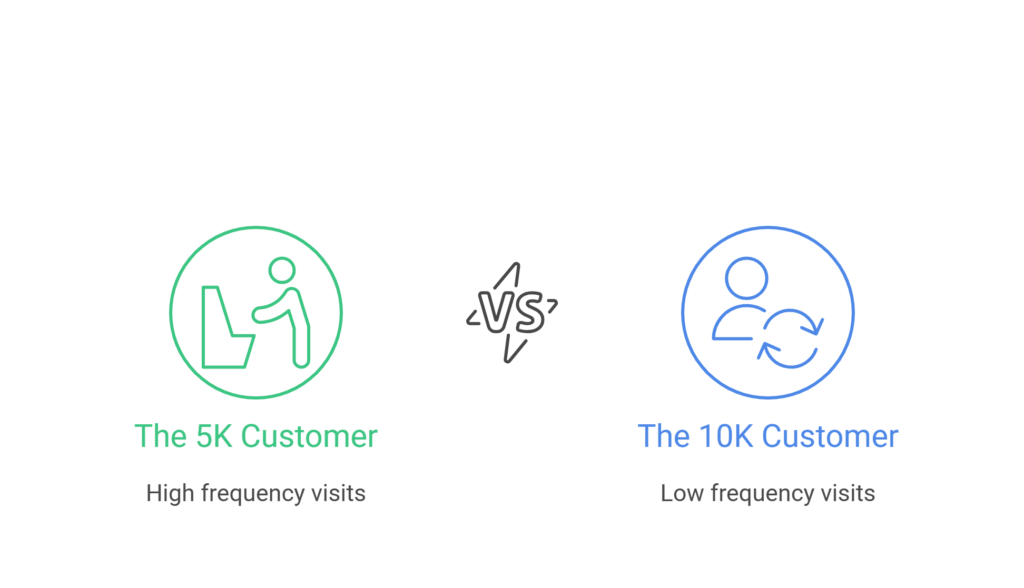
- For 5K Customers: If they didn’t return within 120 days (4 months), we flagged them as “At Risk.”
- For 10K Customers: If they didn’t return within 300 days (10 months), we flagged them as “At Risk.”
This clarity allowed us to set up a Binary Classification Model (0 = Retained, 1 = Churned). Now, we weren’t just guessing; we had a target.
3. Building the Predictive Framework
We guided the technical implementation of a Logistic Regression Model. We chose this specific model because, as business strategists, we need to explain the “Why” to stakeholders. Logistic regression is interpretable—it tells us exactly which factors are driving the customer away.
We analyzed 12 months of historical data (the “Prediction Window”) to predict the next 4 months of behavior.
The Insights We Uncovered
During the modeling process, we discovered 5 key “Churn Drivers” specific to the Saudi market:
1. Service Delay is the #1 Killer We found that delay is exponential, not linear. A customer who is 30 days late has an 18% chance of churning. A customer who is 90 days late has a 65% chance of never coming back.
- Our Strategic Decision: We set our intervention trigger at “Day 90″—the critical tipping point.
2. Usage Velocity We noticed that customers who reduced their visits year-over-year (e.g., from 3 visits in 2023 to 1 in 2024) were signaling disengagement.
3. Vehicle Type Matters Owners of luxury vehicles were churning faster. They demanded a higher level of service that the standard process wasn’t delivering.
4. Complaint History Customers who had logged even one minor complaint had 40% higher odds of churning. This showed us that their “Customer Support” data was disconnected from their “Marketing” data. We worked to bridge that gap.
4. Designing the Intervention: From Data to Action
Data is useless if it doesn’t change behavior. Once we had the model scoring every customer with a “Churn Probability” (0% to 100%), we designed the intervention strategy.
We advised the client to stop using SMS and switch to WhatsApp Business API Automation. In Saudi Arabia, WhatsApp is the primary communication channel. It’s personal, immediate, and high-engagement.
We segmented the customers into risk buckets and focused our budget on the Top 20% High-Risk Customers.
The “Save” Campaign We Designed
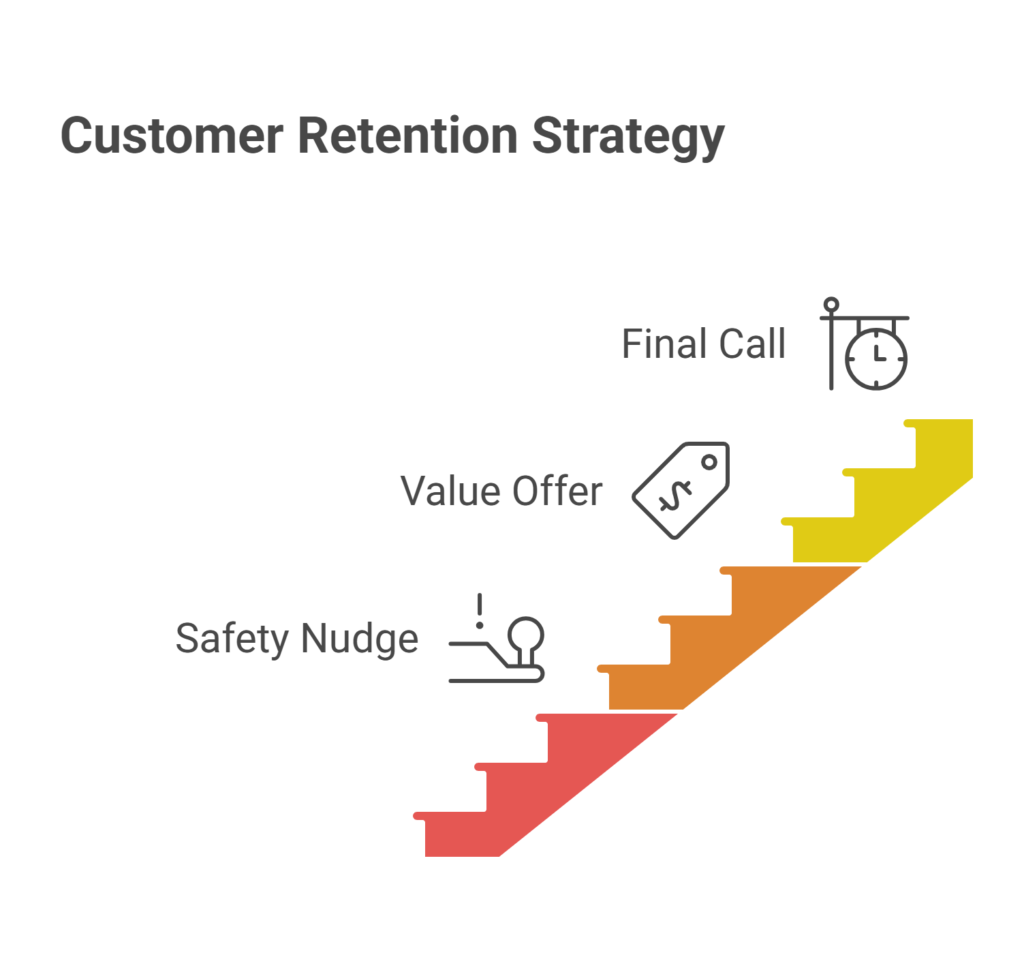
For the high-risk segment (e.g., a 5K customer at Day 90), we created a 3-step automated flow:
- Step 1: The Safety Nudge (Day 90)
- Our Copy: “Dear [Name], your engine oil is past its safe limit. To avoid engine wear, book a check-up today.”
- Strategy: Focus on fear of loss (engine damage) rather than price.
- Step 2: The Value Offer (Day 100)
- Our Copy: “We haven’t seen you in a while! Book in 48 hours and get a Free Safety Inspection + 10 SAR Off.”
- Strategy: A financial incentive to break the inertia.
- Step 3: The Final Call (Day 110)
- Our Copy: “Last chance to redeem your offer. Ensure your vehicle is safe for the road.”
- Strategy: Urgency.
5. The Results: Proof of Impact
To ensure this wasn’t just a theory, we ran an A/B test on 10,000 high-risk customers.
- Group A (Control): 8,000 customers received nothing (Business as Usual).
- Group B (Treatment): 2,000 customers received our WhatsApp intervention flow.
The Financial Outcome The results validated our strategy immediately:
- Retention Lift: The treatment group saw a 78% return rate, compared to only 52% in the control group. That is a 26% lift in pure retention.
- Churn Reduction: Overall, across both segments, we reduced the predicted churn rate by 38%.
Financial Impact (LTV) We presented the results to the management in terms of Customer Lifetime Value (LTV), not just marketing metrics. By saving these customers, we didn’t just gain the revenue from one oil change (120 SAR). We secured their next 3 visits over the coming year.
The program delivered a 24% increase in Net Profit for the target segment, proving that the cost of the WhatsApp messages and discounts was an investment with a high return.
6. Lessons for Leadership
This project reinforced three core principles that we apply in all our consulting work:
1. Strategy Before Tactics We could have easily just “sent more SMS messages.” But without the strategy of predictive modeling and segmentation, we would have burned cash. The MBA approach—analyzing the root cause before acting—was critical here.
2. Personalization is Profit Treating every customer the same is the fastest way to lose them. By using data to identify who needed attention, we allocated resources efficiently.
3. Marketing Must Be Accountable We didn’t report “Open Rates” to the CEO. We reported LTV and Churn Reduction. As marketers, we must speak the language of the boardroom.
Final Thought
This case study is a perfect example of how we work. We don’t just “do digital marketing”; we build ecosystems that solve business problems.
By combining advanced analytics (logistic regression) with accessible channels (WhatsApp) and clear strategy, we helped this Saudi automotive company turn data into a competitive advantage.