Why Location Marketing Fails (And What Actually Works Nearby)
Send download link to:
Automobile service marketing often looks simple from the outside. Coupons are sent, reminders are shared, and dashboards show clicks and redemptions. Yet in real business environments, service conversions rarely behave in a stable or predictable way. In one large automobile service setup operating multiple service centers, this problem continued for a long time despite consistent effort.
The organization had loyal customers, strong brand recognition, and regular discount campaigns. On paper, everything looked correct. Yet service uptake moved up and down without any clear explanation. Some campaigns worked extremely well, while others failed even when the same offer and message were used.
Over time, it became clear that the problem was not customer quality, pricing, or communication channels. The real issue was context.
Service decisions are not continuous. They happen in moments.
Why Service Marketing Behaves Differently
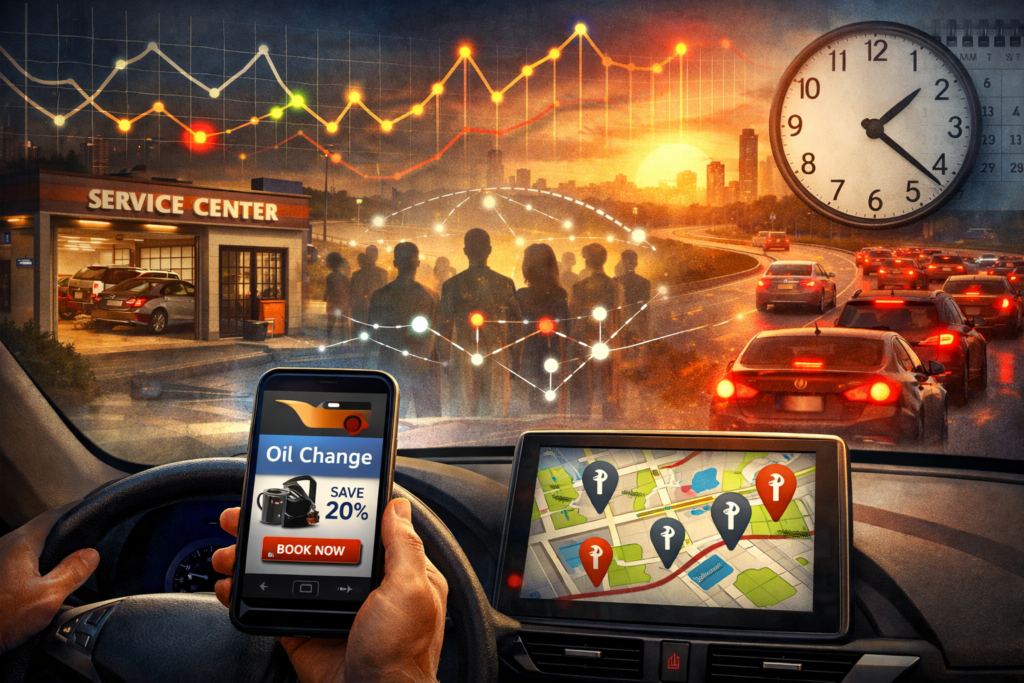
Automobile servicing is not an impulse decision. Customers do not think about oil changes, inspections, or maintenance every day. These decisions surface only in specific situations. A customer might suddenly think about service while driving, passing a service station, preparing for a long journey, or noticing a change in vehicle performance.
Campaign data showed a strong and repeated pattern. The same customer reacted very differently to the same coupon depending on where they were at the moment of receiving it. A coupon delivered while the customer was at home or at work was often ignored. The same coupon delivered while the customer was driving near a service station or along a main road frequently resulted in a booking.
This behavior revealed an important truth. Service intent is situational, not fixed.
Challenge One: Location Data Looked Promising but Failed in Practice
Location data was available from the beginning. Customer location could be captured at the moment a coupon was sent. The early assumption was straightforward. Customers closer to service stations should be more likely to convert.
In practice, this assumption did not hold consistently. Some customers very close to service centers ignored offers. Some customers farther away still booked services. Conversion patterns did not follow simple distance rules.
The reason was fundamental. A location coordinate only shows where a customer is standing. It does not show whether the customer is driving or parked, commuting or stopping, relaxed or rushed. Location without behavior has no meaning.
This was the first major realization. Location alone is not intent.
Challenge Two: Why Traditional Analysis Gave Confusing Signals
Early reporting treated each customer response as independent. Every coupon was evaluated in isolation. Conversion rates were calculated as simple averages. From a traditional analytics perspective, this looked reasonable.
In reality, this assumption was flawed. Customers were not acting independently of one another. Nearby customers were often in the same situation at the same time. Traffic conditions, routes, timing, and local movement influenced multiple customers together.
This meant that customer behavior was correlated by location. When one customer in an area booked a service, nearby customers were often more likely to do the same.
Ignoring this spatial dependency caused misleading conclusions. Campaigns appeared inconsistent because the analysis assumed independence where none existed.
Challenge Three: Behavior Naturally Grouped by Area
As more campaign data was reviewed, service bookings began to show clear geographic clusters. Certain areas became active during specific times. Other nearby areas stayed quiet.
These clusters were not random. They reflected shared conditions. Customers driving the same routes, facing the same traffic patterns, or traveling for similar reasons tended to make service decisions around the same time.
This explained why traditional targeting often failed. It focused on individuals, while real behavior was happening in groups.
Customer behavior naturally grouped by place and time.
Challenge Four: Strong Locations Did Not Stay Strong
After identifying high performing areas, another issue emerged. Locations that worked well during one period often stopped working later. New areas suddenly became active without warning.
Static targeting rules failed quickly. Fixed geofences and predefined high value zones became outdated. Demand moved continuously based on time of day, weekday versus weekend, travel seasons, and traffic patterns.
This revealed another critical insight. Location effectiveness is dynamic.
Challenge Five: Old Data Started Creating Risk
Historical performance initially appeared useful. Areas with strong past results were prioritized. Over time, this approach created blind spots.
Some locations looked strong in reports but showed little current activity. Meanwhile, new demand areas were missed because they had no historical record yet.
Recent nearby behavior proved far more important than long term averages. Decisions needed to reflect what was happening now, not what happened weeks ago.
Learning Before Optimization
Rather than forcing rules early, a learning first approach was taken. A large test campaign was executed where service coupons were sent randomly to a broad customer base over several weeks. No location targeting or time logic was applied.
For every coupon interaction, three things were recorded. The customer real time location, the time of day, and whether a service booking happened within a defined window.
At a high level, performance looked average. But once service bookings were analyzed geographically and over time, the real structure of behavior became visible.
What Location Data Truly Revealed
Service conversions were not evenly distributed. Some areas consistently delivered two to three times higher conversion rates than others. More importantly, these areas kept changing.
A location that performed strongly one week could cool down the next. Another area could suddenly become active due to traffic shifts or travel patterns.
This confirmed that raw location data alone could not explain behavior. Location needed to be interpreted through activity around it.
Why Simple Models Failed
Traditional models assumed that each customer decision was independent and that location was just another variable. This led to unstable predictions and inconsistent results.
Nearby customers influenced one another because they were experiencing the same environment. Ignoring this spatial effect caused biased decisions. Marketing investment was often placed in the wrong places at the wrong times.
This problem is well known in advanced analytics. When spatial dependence exists, naive models fail.
The business needed a way to capture this spatial relationship without turning marketing into a math exercise.
What the SAR Concept Is in Simple Terms
To solve these challenges, the Spatial Autoregressive concept known as SAR was introduced.
In simple words, SAR measures location momentum. It looks at what customers around a location have been doing recently. If many nearby customers have booked services, that area has positive momentum. If activity slows down, momentum fades.
SAR does not treat customers as isolated points. It assumes nearby customers influence each other because they share the same situation.
Instead of asking where the customer is, SAR asks what has been happening around the customer lately.
Recent behavior matters more than old behavior. Nearby activity matters more than distant activity. This allows the signal to update naturally as real world behavior changes.
With SAR, location becomes a live signal rather than a static coordinate.
How SAR Fixed the Independence Problem
Before SAR, each customer decision was treated separately. After SAR, decisions were evaluated within their surrounding environment.
If a customer entered an area where others were actively booking services, the system recognized that service intent was likely high. This was not because the customer profile changed, but because the environment changed.
SAR captured spatial spillover. Demand in one location increased the probability of demand nearby.
This aligned analytics with reality.
How SAR Turned Location Into Intent
Before SAR, location described position. After SAR, location described probability.
When customers entered high momentum areas, they were statistically more likely to convert. Coupons were then used as timely reminders, not aggressive pushes.
Coupons did not create intent. They supported intent already forming.
How Targeting Changed in Practice
Once SAR was applied, coupon strategy changed completely. Offers were no longer tied to fixed customer lists or permanent locations. They were tied to moments.
A customer could receive a coupon one day and not the next depending on where they were and what was happening around them.
The targeting question changed from who should receive the coupon to where service intent is emerging right now.
Business Impact
After implementation, fewer coupons were sent while more services were booked. Conversion rates improved nearly three times compared to earlier campaigns. Marketing costs declined, discount waste reduced, and service demand became more balanced across locations.
With an average service value above SAR 200, this improvement translated into strong incremental revenue without increasing marketing spend.
Customers also responded better. Offers felt timely and helpful rather than promotional noise.
What This Case Changed About Service Marketing
The most important lesson from this automobile service case was clear. Coupons do not create demand. They only accelerate decisions when demand already exists.
SAR allowed location to shift from geography to intent. Marketing stopped chasing customers and started responding to situations.
This transformed marketing from customer targeting to moment targeting.
Final Takeaway
Location driven marketing is not about fixing weak locations or pushing underperforming service centers. It is about recognizing where service intent already exists and acting at the right time.
When location is treated as behavior instead of a map point, marketing becomes smarter, more respectful, and far more effective.
In automobile services, growth does not come from sending more coupons.
It comes from understanding when and where customers are ready to decide.