In the modern digital landscape, businesses are often forced to choose between two opposing forces.
On one side, there is the pressure for immediate results. We want sales today. We want to see the Return on Ad Spend (ROAS) in our weekly reports. This is the marketing equivalent of a sugar rush—it feels great in the moment, gives you a spike in energy, but leaves you crashing and hungry again an hour later.
On the other side, there is the need for longevity. This is the balanced diet and exercise of the business world. It doesn’t show results on the scale overnight, but it is the only way to build a body that survives for decades.
Far too many companies today are addicted to the sugar rush. They are winning the daily battle for sales but losing the long-term war for market share. They are stuck on what I call the “Performance Treadmill”.
If you stop running your ads, do your sales stop immediately? If the answer is yes, you don’t have a brand; you have a dependency.
There is a way out of this trap. It is based on data from hundreds of the world’s most successful campaigns. It is called The 60/40 Rule.
The Central Challenge: The ATM Analogy
Every marketer manages two different time horizons. To understand the relationship between them, think of your brand as a Bank Account.
1. Short-Term Activation (The Withdrawal)
This is what most digital marketers spend their days doing. The focus is capturing existing demand.
- Objective: Drive immediate sales and ROI.
- Tools: Performance ads, discounts, paid search.
- The Analogy: This is like going to the ATM and withdrawing cash. It puts money in your pocket right now to pay the bills. But you cannot withdraw money from an empty account.
2. Long-Term Brand Building (The Deposit)
This is often neglected because it is harder to measure. The focus is creating future demand.
- Objective: Strengthen brand preference and loyalty.
- Tools: Emotional storytelling, sponsorships, consistent branding.
- The Analogy: This is like depositing your paycheck. It builds up your balance (Equity) so that future withdrawals are possible.
The problem? Most businesses are trying to make withdrawals every single day without ever making a deposit. Eventually, the account hits zero.
The Treadmill Effect: Running Fast to Stand Still
When a brand becomes addicted to performance ads and constant promotions, it triggers the “Treadmill Effect”.
Imagine a hamster on a wheel. The hamster runs furiously (spending budget), sweating and working hard. But the moment the hamster stops running, the wheel stops turning. It has no momentum.
Similarly, when you rely 100% on activation:
- Margins Shrink: You train customers to wait for a sale, just like training a dog to only sit when it sees a treat.
- Costs Rise: Every new sale becomes more expensive because you have fished out the pond and haven’t restocked it.
- Brand Perception Drops: You move from being a premium brand to a commodity.
As the saying goes: “When your brand stops running, your sales stop breathing”.
A Cautionary Tale: The Hoover Disaster
History gives us a brutal example of what happens when you prioritize a short-term offer over long-term business health.
In the 1990s, Hoover UK launched an unbeatable offer: buy a £100 product, get a free flight to America. It was the ultimate “sugar rush.” Sales exploded overnight.
But they forgot the long-term reality. The company couldn’t fulfill the promise. The brand reputation collapsed, lawsuits flooded in, and the company lost £50 million. They sacrificed the Golden Goose (the Brand) for a single Golden Egg (the Sales Spike).
The Solution: The 60/40 Rule
So, what is the right balance? How much should you spend on “Harvesting” versus “Planting”?
According to Les Binet and Peter Field, the optimal balance for maximum growth is roughly 60/40.
- 60% of your budget should go to Long-Term Brand Building.
- 40% of your budget should go to Short-Term Activation.
The Orchard Analogy
Think of your business as an apple orchard.
- Activation (40%) is the act of picking the apples. It’s necessary, rewarding, and feeds you today.
- Brand Building (60%) is the act of watering the trees, planting new saplings, and ensuring the soil is fertile.
If you spend 100% of your time picking apples and 0% of your time watering the trees, you will have a record-breaking harvest this year. But next year? The trees will be dead.
Activation captures the demand that Brand Building creates. You must plant the seeds before you can harvest the crop.
Proof It Works: The Airbnb Pivot
You might think, “I’m not Coca-Cola; I can’t afford to plant trees for 5 years.” But look at Airbnb.
During the pandemic, they made a massive pivot. They cut their performance advertising spend (stopped picking the fruit) and focused on brand storytelling (watered the roots).
The result? Over 90% of their traffic became direct or organic.
Because they had a strong brand, they didn’t need to “rent” their customers from Google or Facebook. A strong brand is like owning your own house instead of paying rent every month. It reduces your future costs.
How to Measure Success: The Two Dashboards
One of the biggest reasons companies fail to implement the 60/40 rule is that they use the wrong ruler.
Dashboard 1: The Hunter (Efficiency)
Measures the kill.
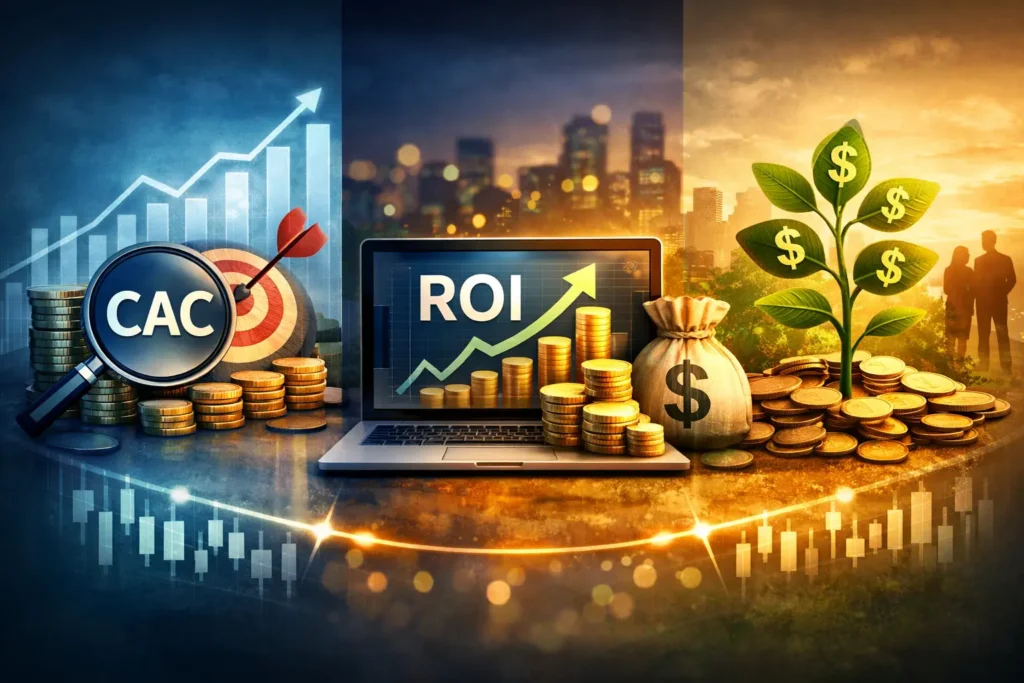
- Metrics: CAC, ROAS, Conversion Rate.
- The Trap: If this dashboard is green, you feel safe. But you might be hunting the species to extinction.
Dashboard 2: The Farmer (Equity)
Measures the health of the land.
- Metrics: Brand Awareness, Retention, Direct Traffic, Lifetime Value (LTV).
- The Goal: You want to see the soil quality improving over 6 to 12 months.
If the “Hunter” dashboard is green but the “Farmer” dashboard is red, you are winning battles but losing the war.
Conclusion: Profit Today, Power Tomorrow
The goal of the 60/40 rule is not to stop selling. It is to make selling easier.
- Short-term marketing sells a product. Long-term marketing builds a legend.
- Speed gets you noticed. Consistency makes you trusted.
The world’s most successful companies—from Nike to Disney—treat their marketing like an investment portfolio. They keep 40% in “Cash” (Sales Activation) to pay the bills today, but they invest 60% in “Equity” (Brand Building) to ensure they are wealthy tomorrow.
Stop running on the treadmill. Start building an engine.