How a Simple Loyalty Program Turned Hidden Data Into 1,030 SAR of Profit
Send download link to:
The Obsession with “New”
In the world of business and marketing, there is a trap that almost every company falls into at some point. It is the obsession with “new.”
You see it in every boardroom meeting and hear it in every strategy session. When leadership asks, “How do we grow this year?” the answer is almost always the same: “We need more customers.”
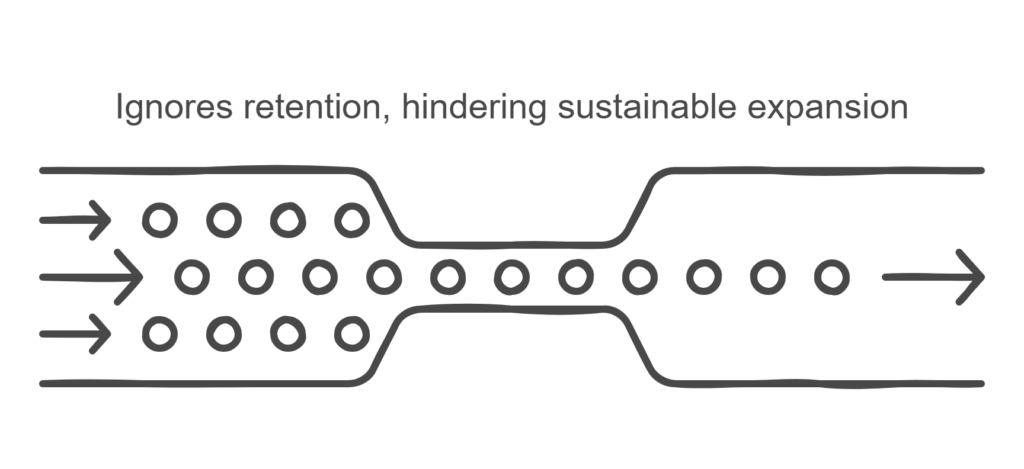
We pour millions into advertising. We obsess over our acquisition funnels. We celebrate every time a new lead fills out a form or a new foot walks through the door. It feels like progress. It looks like growth.
But recently, I worked on a case that proved that this obsession can sometimes blind you to the actual money sitting right in front of you.
I want to tell you the story of an automobile service company that was doing everything “right” when it came to getting new customers, but was still struggling to grow their long-term revenue.
By shifting their focus from hunting for new people to taking better care of the ones they already had, we unlocked an additional 1,030 SAR in pure profit for every single customer we engaged.
Here is how we did it, and more importantly, how you can look for the same opportunity in your business.
The Mystery of the Leaky Bucket
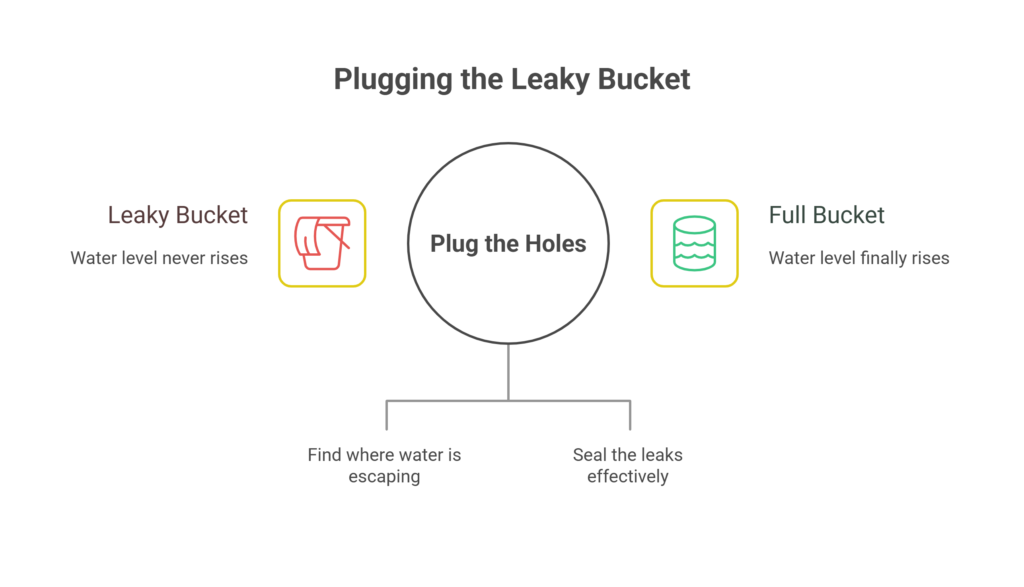
Imagine you are trying to fill a bucket with water. You have the hose turned on full blast. Water is pouring in faster than ever. But no matter how long you stand there, the water level in the bucket never seems to rise.
Why? Because there are holes in the bottom.
This was exactly the situation this company was facing.
When we started our initial analysis, the marketing team was actually doing a fantastic job. Their dashboards were green. They were bringing in new customers through digital channels, social media, and ads, and they were beating their acquisition targets.
But when we zoomed out and looked at the long-term revenue, the line was flat.
We realized that while people were walking in the door, they weren’t staying. A customer would come in for a routine car service once, maybe twice, and then we would never see them again. They were churning.
In marketing, we call this the “Leaky Bucket” problem. You can spend all the money in the world on a bigger hose (acquisition), but if you don’t plug the holes in the bucket (retention), you will never actually grow.
We knew we had to stop looking at how to get more people and start figuring out why the current people were leaving.
Playing Detective with Data
We decided to go deep into the data. We didn’t want to look at the averages; we wanted to look at behavior.
We asked the analytics team to pull a very specific set of data: We wanted to look at a group of customers who had joined the company exactly eight years ago. We wanted to see what happened to them over time. Who stayed? Who left? And most importantly—what was different about the ones who stayed?
As we combed through the history of visits, service frequency, and churn patterns, a very clear picture began to emerge.
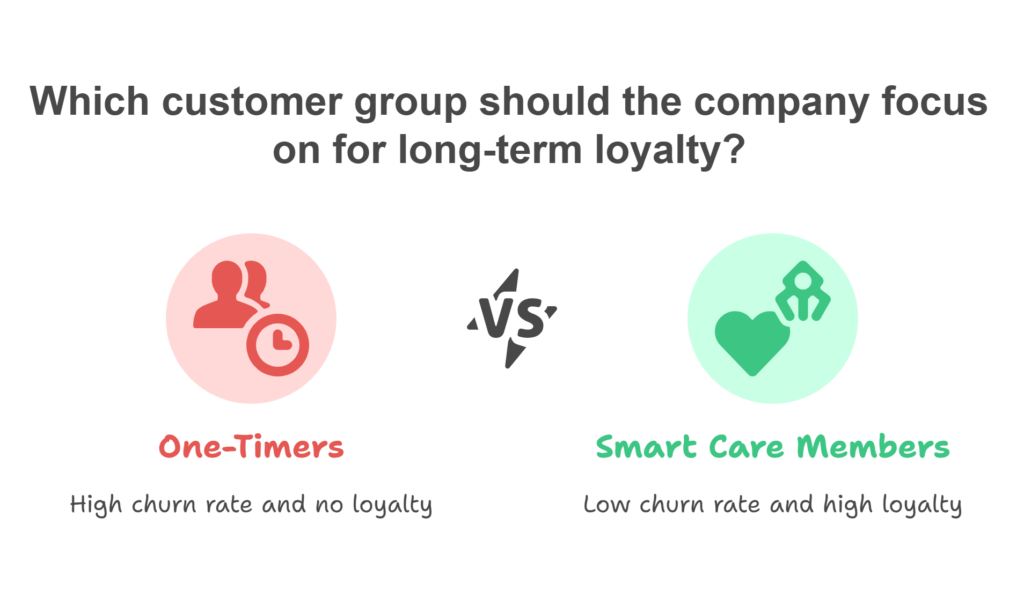
We found that the customer base was essentially divided into two very different groups.
Group A: The One-Timers These customers treated the service center as a commodity. They came when they had an emergency or a specific need, but they had no loyalty. They were here today, gone tomorrow.
Group B: The “Smart Care” Members Then, we noticed a second group. These were customers who had signed up for a voluntary program the company offered called “Smart Care”.
Now, Smart Care wasn’t anything complicated. It wasn’t a complex subscription with confusing tiers. It was simple. If you joined, you got:
- Automatic reminders when your car needed maintenance.
- Pre-scheduled dates so you didn’t have to worry about booking.
- Priority slots so you didn’t have to wait in line.
- Some basic loyalty points.
It was a program designed to make the customer’s life easier.
When we compared these two groups, the difference in loyalty was shocking.
In the very first year after joining, 18% of the “One-Timers” would leave and never come back. But for the “Smart Care” members? Only 9% left.
Just by being in this simple program, the churn rate was cut in half.
As we looked further down the timeline, the gap got even wider. By the eighth year, only about 17% of the original One-Timers were still customers. But 34% of the Smart Care members were still happily servicing their cars with us.
We had found the patch for the leaky bucket.
Turning Loyalty into Simple Math
As a strategist, I have learned one hard lesson: You cannot walk into a boardroom and just say, “Customers love this program.” You have to show the money.
We needed to prove that these Smart Care members weren’t just “nice to have”—we needed to prove they were more profitable.
So, we did some simple math to compare the value of the two groups.
First, we looked at how much money they spent. The average “One-Timer” (Non-Smart Care) spent about 460 SAR per year with us. The average Smart Care member spent 520 SAR per year.
That makes sense, right? If you have a program that reminds you to service your car, you are more likely to come in for that service. They were spending more because we were helping them remember to take care of their vehicle.
Then, we looked at the cost. This was the surprising part. It cost the company exactly the same amount—40 SAR—to service both types of customers. Sending an automated text message reminder or giving a priority slot didn’t actually cost the company extra money in operations.
So, we had a customer who spent more money (Revenue) but cost the same to serve (Cost). That means they were significantly more profitable.
The 1,030 SAR “Aha!” Moment
We decided to calculate the “Lifetime Value” (LTV) of these customers.
If you aren’t familiar with LTV, think of it as “Future Value.” It is a way of estimating how much total profit a single customer will give you for the rest of their relationship with you, measured in today’s dollars.
We ran the numbers, accounting for the fact that Smart Care members stay years longer than the others.
The results were crystal clear:
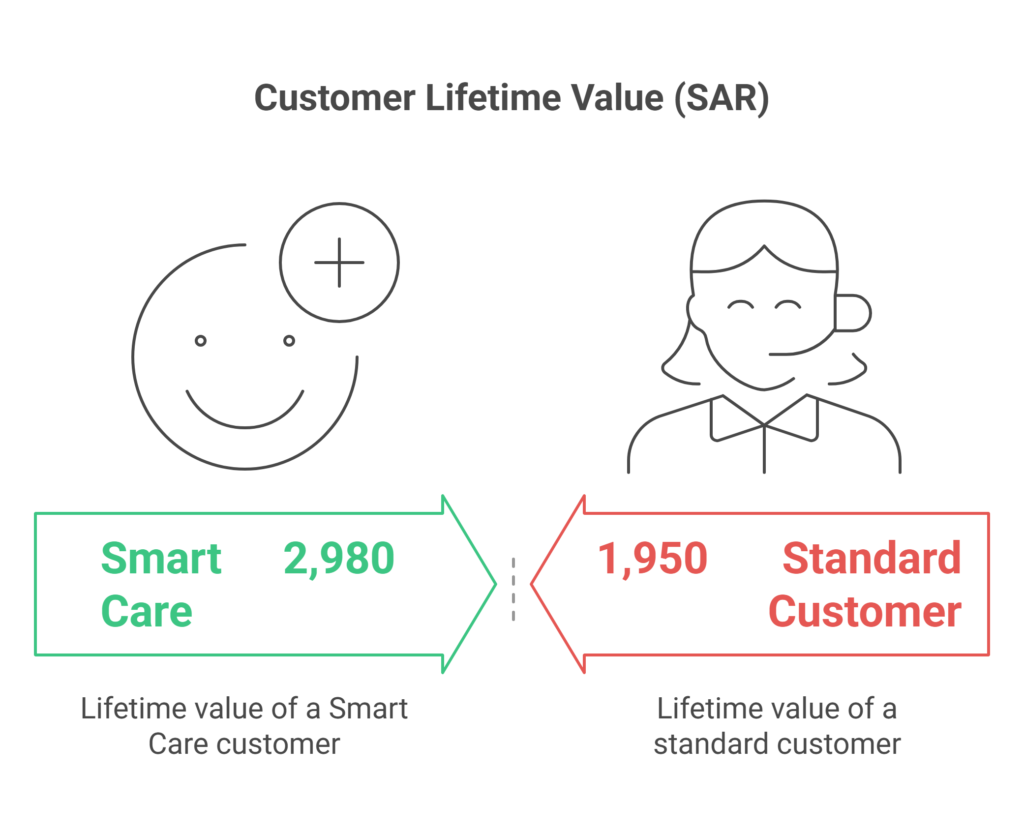
- The Lifetime Value of a standard customer was 1,950 SAR.
- The Lifetime Value of a Smart Care customer was 2,980 SAR.
Do you see the difference? It is 1,030 SAR.
That number changed everything.
It meant that every single time a customer walked up to the counter and said, “Yes, I’ll join Smart Care,” the company just made an extra 1,030 SAR in future profit.
It wasn’t just a loyalty program anymore. It was a strategic asset.
The Big Opportunity
Here is where the strategy comes in. We knew the program was valuable. But when we looked at the customer base, we saw a massive problem.
Only 28% of new customers were actually enrolled in Smart Care.
That meant 72% of customers were walking out the door without joining. They were walking out as “One-Timers,” statistically destined to churn, leaving that extra 1,030 SAR on the table.
Why weren’t they joining? Because enrollment was passive. The company waited for the customer to ask about it, or for a busy service advisor to remember to mention it.
We realized we had a huge opportunity. If we could just get more people to sign up, the revenue impact would be enormous.
And because we knew the value of a signup was 1,030 SAR, we knew we could afford to spend a little bit of money to make it happen.
The Plan: Making it Impossible to Say “No”
We didn’t need a complex digital transformation. We just needed to change human behavior—both for the customers and for the staff.
We put together a simple, three-part plan to capture this untapped value.
1. The Customer “Hook” (Incentives)
We knew that asking someone to fill out a form is boring. We needed to give them a reason to do it now. Since a signup is worth over 1,000 SAR to us, why not give a little bit of that back to the customer?
We recommended simple, low-cost perks for joining:
- “Sign up today and get 20 to 50 SAR off your next service.”
- “Join now and get a free car wash.”
- “Get a free small accessory just for enrolling.”
These things cost the company very little, maybe 20 or 30 SAR. But to the customer, they feel like real value. And statistically, trading 30 SAR today to make 1,030 SAR later is the best investment you can ever make.
2. The Staff “Push” (Bonuses)
The best strategy in the world fails if the person at the front desk doesn’t care. The Service Advisors are busy. They have phones ringing and cars to move. Asking them to “sell” a loyalty program is just extra work.
Unless you make it worth their while.
We introduced a micro-bonus. We recommended giving the Service Advisor 5 SAR for every single successful enrollment.
It sounds small, but it adds up. If an advisor signs up 10 people a day, that’s lunch money. If they sign up 100 in a month, that’s a nice bonus. Suddenly, the staff wanted to talk about Smart Care. We also gave them a simple script so they knew exactly what to say to make it easy.
3. Making it Easy (System)
Finally, we removed the friction. We added prompts at the billing counters and made it possible to join with one tap on the mobile app. If it takes more than 30 seconds to join, people won’t do it. We made it instant.
The Result: A Green Light for Growth
When we presented this to the leadership team, it was one of the easiest approvals I have ever seen.
Usually, asking for budget for “discounts” or “bonuses” is a fight. But because we had the data, it wasn’t an expense—it was an investment.
The leadership saw clearly that spending 50 SAR on incentives to unlock 1,030 SAR in value was a no-brainer. They approved the immediate rollout of the program across all centers.
The beauty of this strategy is that it didn’t require hiring a new agency or buying expensive software. It was about looking at the assets the company already had—their data and their existing customers—and finding a smarter way to use them.
What This Means For You
I wanted to share this story because it highlights a truth that is often ignored in digital marketing.
We get so caught up in the technology—the AI, the algorithms, the ad platforms—that we forget the business fundamentals.
Growth isn’t just about the number of people coming in. It’s about the value of the people staying.
If you are a business leader or a marketing manager, I challenge you to look away from your acquisition dashboard for a moment. Look at your current customers.
- Do you know who stays and who leaves?
- Do you know why they stay?
- Do you know exactly how much more a loyal customer is worth compared to a one-time visitor?
Somewhere in your data, there is a “Smart Care” pattern waiting to be found. There is a segment of customers who love what you do. If you can identify them, quantify their value, and build a strategy to create more of them, you won’t just hit your quarterly targets. You will build a business that is profitable for the long haul.
Your biggest growth opportunity might not be out there in the market. It might be hiding right there in your own database, just waiting for you to find it.